


It is a urinary diversion catheter consisting of a small-caliber, multi-perforated flexible tube curved on both sides. This catheter connects the kidney to the bladder to help facilitate urine flow.
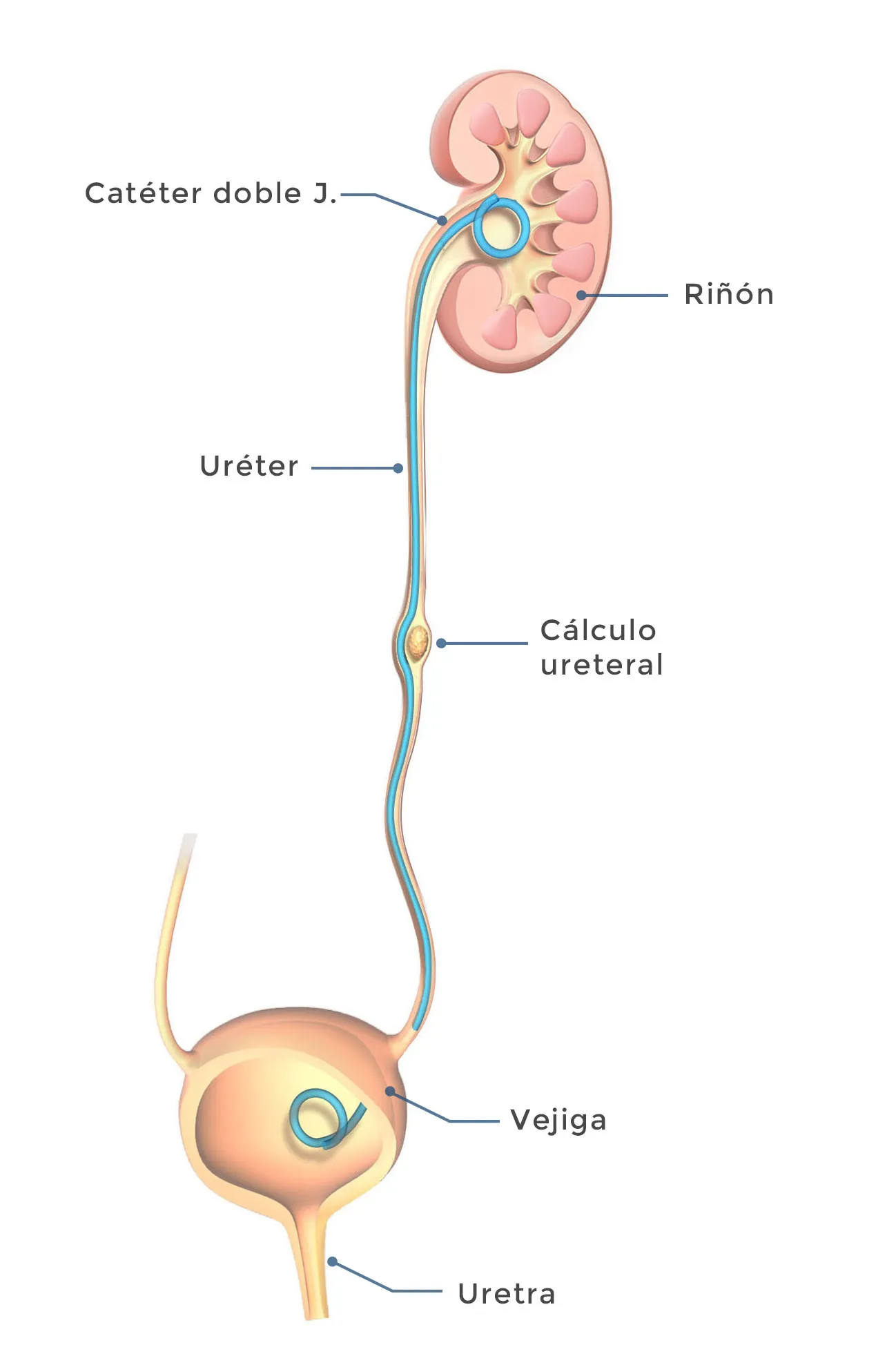
The double J catheter is placed using endoscopic techniques, meaning through natural body orifices, making it a very simple procedure. If properly placed, it should not be visible outside the body.1
When is a double J catheter used?
In most cases, a double J catheter will be placed if you experience urinary retention that cannot be resolved immediately. The most common causes of these obstructions are: lithiasis (stones), urinary infection, and stenosis (a scar that narrows the urethra).
The length of time you can wear a double J catheter depends on each case. You might wear it for only a few days, several weeks, or even months. In any case, the double J catheter has a limited lifespan, and it is recommended to replace it within periods shorter than 6 months.
What complications can a double J catheter entail?
It is possible that after the placement of a double J catheter, you may experience some of the following symptoms:
- Pain or discomfort in either of the two described areas.
- Pain or discomfort when urinating or moving.
- Increased frequency of urination.
- Continuous urge to urinate.
- Waking up at night to urinate.
- Blood in the urine.
If the double J catheter is left in for longer than recommended, it is possible that:
- Calcifications may form on the catheter, making its removal a surgical procedure.
- Kidney stones may appear.
- You may develop a urinary infection.
- You may experience pain when moving, urinating, and even at rest.
What should I do if I have a double J catheter?
Several studies recommend monitoring urinary pH to measure catheter calcification. 3-4
It is advisable to maintain urinary pH between 5.8 and 6.2.
To keep your urinary pH within range, we recommend:
- An appropriate diet along with a food supplement that helps acidify, such as Lit-Control pH Down. You can consult with our specialized nutritionist.
- Remember that you can take supplements formulated with ingredients that help maintain urine in optimal conditions, preventing the accumulation of minerals and incrustation in catheters, probes, and other urological devices.
Sources:
1. https://clinica-urosalud.es
2. https://www.clinicaurosur.com
3. Hedelin H, Bratt CG, Eckerdal G, Lincoln K (1991) Relationship between urease producing bacteria, urinary pH and encrustation on an indwelling catheter. Br J Urol 67(5): 527–32.
4. Burr RG, Nuseibeh IM (1997) Urinary catheter blockage depends on urine pH, calcium and rate of flow. Spinal Cord 35(8): 521–5.


